

Overthinking: When Your Brain Just Won’t Stop

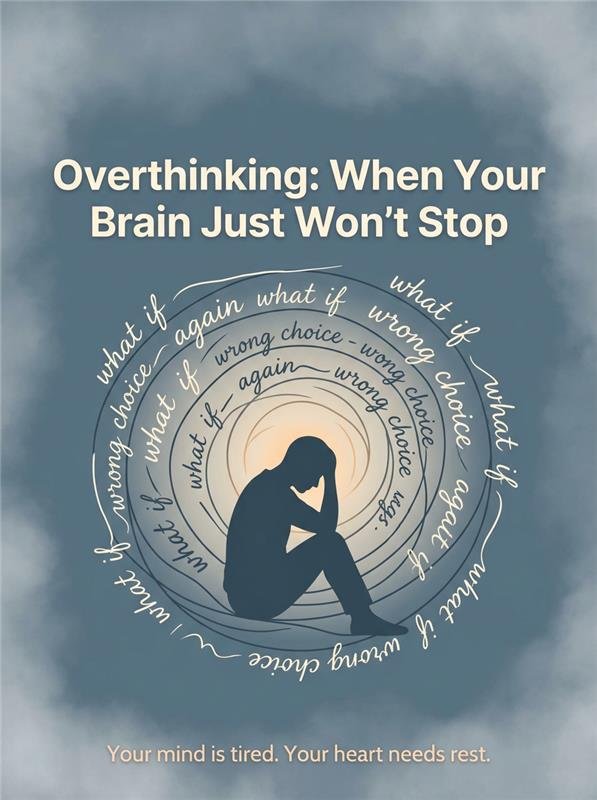
Some days, the mind just won’t stop talking.
You play back one conversation. One mistake. One option. One worry.
Over and over.
You try to move on, but the same thought keeps coming back in different ways.
“What if I said the wrong thing?”
“What if something goes wrong?”
“What if I choose the wrong thing?”
This is how it feels to think too much. Not only are you thinking deeply, but you also feel like you’re stuck in a mental loop that you can’t easily get out of.
And the hardest part is that it might look fine from the outside. But on the inside, there is exhaustion, confusion, and a constant feeling of pressure.
Overthinking is more than just thinking too much.
People often think that overthinking is just “using the mind too much.” But in a lot of cases, it goes deeper than that.
It can come from feeling restless inside, being emotionally unstable, being afraid of making mistakes, or needing to control every possible outcome.
The mind tries to make things safe by thinking about everything when life is uncertain. It keeps looking for the best way to avoid pain or failure, the best answer, and the best time.
But instead of making things better, this habit usually makes things worse.
The mind gets too busy. The body stays awake. And over time, a person starts to feel tired even when they don’t do much physically.
Why Do People Think Too Much?
There is usually a reason why someone starts to overthink. It frequently arises when an individual is burdened with unprocessed emotional stress.
This could happen when:
life seems unclear or uncertain
You are scared of making the wrong choice, you want everything to go perfectly, you have been hurt emotionally before, you are carrying stress without saying anything, and you find it hard to trust the process of life.
When this happens, overthinking becomes a way to deal with things. The mind keeps working because it is afraid that if it stops, something bad will happen.
So even taking a break becomes hard.
Signs that you may be overthinking
People don’t always know they’re overthinking until it starts to get in the way of their daily lives.
You might see it when:
you keep thinking about the same things over and over again
You get tired of making small decisions, you often think about the worst things that could happen, you can’t sleep because your mind is always racing, you get mad over little things, you can’t focus on the present, and you keep looking for comfort but still don’t feel settled.
This mental loop can start to affect your emotional balance, relationships, and physical health over time.
What happens to the body when you overthink
There is a strong connection between the mind and body. The body has a hard time relaxing when the mind is always on the go.
A lot of people who overthink also say they have physical symptoms like:
heavy head, frequent headaches, trouble sleeping, stomach problems or acidity, trouble concentrating and remembering things
being irritable and tired mentally
When the nervous system doesn’t get enough rest, the body stays in a state of low-level stress. The system acts like it needs to stay alert, even when there isn’t any danger right away.
This is why overthinking isn’t just something that happens in your head. It can turn into a full-body experience.
The real problem is often buried under the thoughts.
Thoughts are usually just the tip of the iceberg.
There is usually something deeper behind repetitive thinking:
fear, not feeling safe, feeling too many emotions, sadness, pressure, or a need for certainty that isn’t spoken.
This is why telling someone to “stop thinking so much” doesn’t work very often.
Because the mind doesn’t make thoughts for no reason.
It is trying to keep something weak inside safe.
When we stop fighting our thoughts and start to understand what they are trying to tell us, real healing begins.
What Helps in Breaking the Pattern?
Getting over overthinking doesn’t mean making your mind go blank. It’s about carefully getting the system back to safety, clarity, and balance.
Some people feel better when they:
- Being aware of your feelings
Instead of asking, “Why am I thinking this way?” ask, “What am I feeling under this?”
Fear, confusion, pain, or pressure are often the real answers.
- Taking your time with the need for perfect answers
Not every question in life can be answered right away. We often find peace when we stop expecting ourselves to be completely sure.
- Getting back to clarity inside
Even easy things seem hard when your mind is full. Gentle reflection, grounding exercises, and emotional support can all help you clear your mind.
- Helping the emotional root
If your habit of overthinking is linked to feeling insecure or having unresolved emotional stress, deeper healing support can really help.
A Soft Way to Find Inner Peace
For people who feel stuck in their thoughts, healing shouldn’t feel harsh or forced.
It should be safe.
There is often gentle support available for emotional healing that helps calm the mind’s repetitive patterns, ease internal restlessness, and bring more clarity from within.
This kind of help doesn’t mean stopping thoughts. It’s about making the person feel more stable emotionally so that their mind doesn’t have to keep going in circles.
When you feel more secure inside, the noise in your head often starts to fade on its own.
You Don’t Have to Keep Thinking the Same Thing Over and Over
You are not weak, broken, or “too sensitive” if you see yourself in this pattern.
You might just be holding too much inside and not having enough room to let it go.
When you think too much, it usually means your mind is tired and your heart needs help.
You can feel lighter, clearer, and more at peace with yourself if you get the right help, become more aware, and heal your emotions.
One easy step could start that change:
realizing that you don’t have to figure everything out in your head alone.
Last Thought
Having a lot on your mind doesn’t always mean you have a strong mind.
Sometimes, it’s your mind that needs a break.
And when that rest comes—through clarity, emotional support, and inner healing—life starts to feel softer, calmer, and easier to handle.
If you feel like you’re stuck in a loop of the same thoughts, take a break and really listen to what you’re saying.
Letting go can be the best thing for healing to start.
Leave a Reply